![[Roundtable Vol. 3] A 25-Year Debt? The "God Table" Trap in System Integration—Tactna’s Vision for Ideal User Management](/_next/image?url=https%3A%2F%2Fimages.microcms-assets.io%2Fassets%2Fd9fc9c4a1d544864b10602bcd9279d34%2F1a5dae2a426c43d49adcb0ac7684a0c9%2F%25E8%25AA%258D%25E8%25A8%25BC%25E3%2583%25BBID%25E7%25AE%25A1%25E7%2590%2586%25E9%2596%258B%25E7%2599%25BA%25E8%2580%2585%25E5%25BA%25A7%25E8%25AB%2587%25E4%25BC%259A%25E3%2582%25B7%25E3%2583%25AA%25E3%2583%25BC%25E3%2582%25BA(3).png&w=3840&q=75)
[Roundtable Vol. 3] A 25-Year Debt? The "God Table" Trap in System Integration—Tactna’s Vision for Ideal User Management
目次
TL;DR: Key Takeaways (30-Second Summary)
- The "Real" Barrier to ID Integration: The biggest hurdle isn't just the technical shift; it's the fear of disrupting established operational workflows.
- The "God Table" Trap: Coupling user management too deeply with a specific application creates massive technical debt. Our CEO, Sudo, shared how Topcoder spent 25 years overcoming this legacy burden.
- Tactna’s Solution: Our API-based, loosely coupled design allows for a phased migration without breaking your current business operations.
- Future-Proofing for AI Agents: In an era where human and AI agents share IDs, buying a "future-proof structure" is the fastest way to accelerate business speed.
Introduction
Hello, I’m Manami Aso from the Corporate Department at TC3.
We recently held our third Tactna Roundtable. While our previous sessions dived into the importance and technical foundations of ID integration, this time we went deeper: "Why do so many customers hesitate to integrate IDs?" and "What does user management that truly accelerates business look like?".
Joining me were our CEO Yoshito Sudo, engineers Ryosuke Iwakura and Yuki Sanada, and myself. From real-world struggles to Sudo’s "25-year technical debt" story, here are the highlights!
1. "We need to integrate IDs..." So why can't we take the first step?
.png)
Aso: Through our last two talks, I’ve learned how secure and cost-effective Tactna is compared to building in-house. But in reality, don't customers feel that "touching a system that’s running right now is just too terrifying"?
Sudo: That fear is actually quite valid. When you stand at the starting line of ID integration, you face two major "pains". One is the technical pain of switching authentication mechanisms. The other—and often greater—pain is the need to overhaul business operational flows that are currently running perfectly.
Iwakura: Exactly. You can estimate technical costs, but operational changes have a massive blast radius that can shake the entire business. For example, the fear of changing call center workflows or signup processes is often the biggest reason integration stalls.
Sanada: Because the operational load is high, the key is "how to migrate gradually without disrupting current flows". If customers feel confident they can transition step-by-step rather than through a "big bang" approach, they can finally move forward.
2. Tactna’s Answer to the "Operational Wall"
.png)
Sudo: What Tactna aims for is exactly that—"lowering the hurdle." Since Tactna is API-based, it can be introduced with minimal changes to existing operations.
Sanada: It’s a design philosophy of "loose coupling by service." This allows you to freely define rules for each service regarding the ID lifecycle—meaning when a user starts using it, when they change attributes, and when they stop using it.
Iwakura: As we discussed in a recent project, we can propose a standard pattern where "Tactna handles sign-ups, and the app handles post-login processing." This keeps the app-side logic simple. It’s a balance that allows customers to receive the benefits of a new platform without destroying their existing flows.
Sudo: We consolidate the "core of security" like IDs and passwords while keeping changes to other business processes to a minimum. I am confident that this "phased migration process" is a major benefit of choosing Tactna.
Sanada: For customers who don't know where to start, our greatest strength is being able to provide a "template" by saying, "Let's start by defining the ID lifecycle (the sequence from registration to deletion)."
3. The "God Table" Trap and the Lesson from Topcoder
.png)
Aso: During our discussion, the term "God Table" mentioned by Sudo-san was very striking. What exactly does this mean?
Sudo: User management is the "heart" of every application. That is why people tend to create a "God Table"—a god-like table—by placing user information within a specific app's database and attempting to have all other apps reference it. However, this is a very dangerous trap.
Sanada: If you center everything on a specific app, the downsides of tight coupling emerge: modifications to that app affect the entire system, and it becomes difficult for other vendors to intervene.
Sudo: That's right. It’s not just about having multiple apps; the same thing happens when you continue expanding a single system's functionality over many years. My experience at "Topcoder" (the company operating one of the world's largest competitive programming communities, where Sudo served as Head of R&D before founding TC3) feels like the true origin of Tactna. Topcoder had a system that had been running for over 10 years, but the user table was built solidly into a specific old database. We were in a helpless situation where multiple services and functions were each adding modifications and extensions to it.
Aso: Even with many talented engineers, was it impossible to improve?
Sudo: That’s the thing—it was impossible. At the time, it was an organization of up to 200 people, but every function was tightly coupled to that "God Table," and no one could grasp the impact of any modification. While I was there, we managed with "first aid" measures, but a fundamental solution was too costly to touch.
Aso: How long did it take to finally escape from that?
Sudo: I heard they finally achieved a fundamental solution late last year, so it took 25 years. It had become so tightly coupled that it required "master-level" maintenance, which significantly hindered business development. Because I know the terror of this "legacy burden," I believe user management must be decoupled from specific apps and built as an independent platform with a high level of abstraction.
4. Build vs. Buy: Why Tactna, Not In-House?
.png)
Iwakura: Some customers think building a scratch system is easier. But if you try to build a proper common platform, you end up building Tactna anyway.
Sudo: Exactly. It eventually comes down to: "Who decides the rules for CRUD (Create, Read, Update, Delete) operations across multiple apps?"
Sanada: Imagine multiple apps trying to update a single user list in Excel simultaneously. Who has priority? Who can overwrite? Tactna provides the interface and expertise for this complex "traffic control" as a pre-packaged solution.
Sudo: Building it yourself takes enormous time, and you often end up being dragged down by specific app requirements, creating yet another "God Table". Buying Tactna isn't just about a system; it's about getting an "organized blueprint" to maintain business agility for the future.
5. The Security Prerequisite: Returning to "1 User, 1 ID"
.png)
Iwakura: As a future standard, we must strongly advocate for the premise of "1 User = 1 ID = 1 Email Address".
Sudo: Exactly. While there are cases where IDs have been shared in the past due to historical reasons, considering current security standards, this is a non-negotiable point. It’s about establishing individual identity by placing the email address as the primary attribute of the ID. I believe organizations that fail to do this will struggle to move forward with their digital transformation (DX) initiatives.
Sanada: In the future, I’d like to consider a step-up license model that can be started more affordably—starting with simple management and gradually moving toward features like "My Page" and advanced integration.
Sudo: It’s like the saying "from the cradle to the grave"; I want Tactna to be a product that consistently stays by our customers' side, from the initial system launch phase all the way to large-scale integration.
6. A Vision for the Future: ID Management in the AI Agent Era
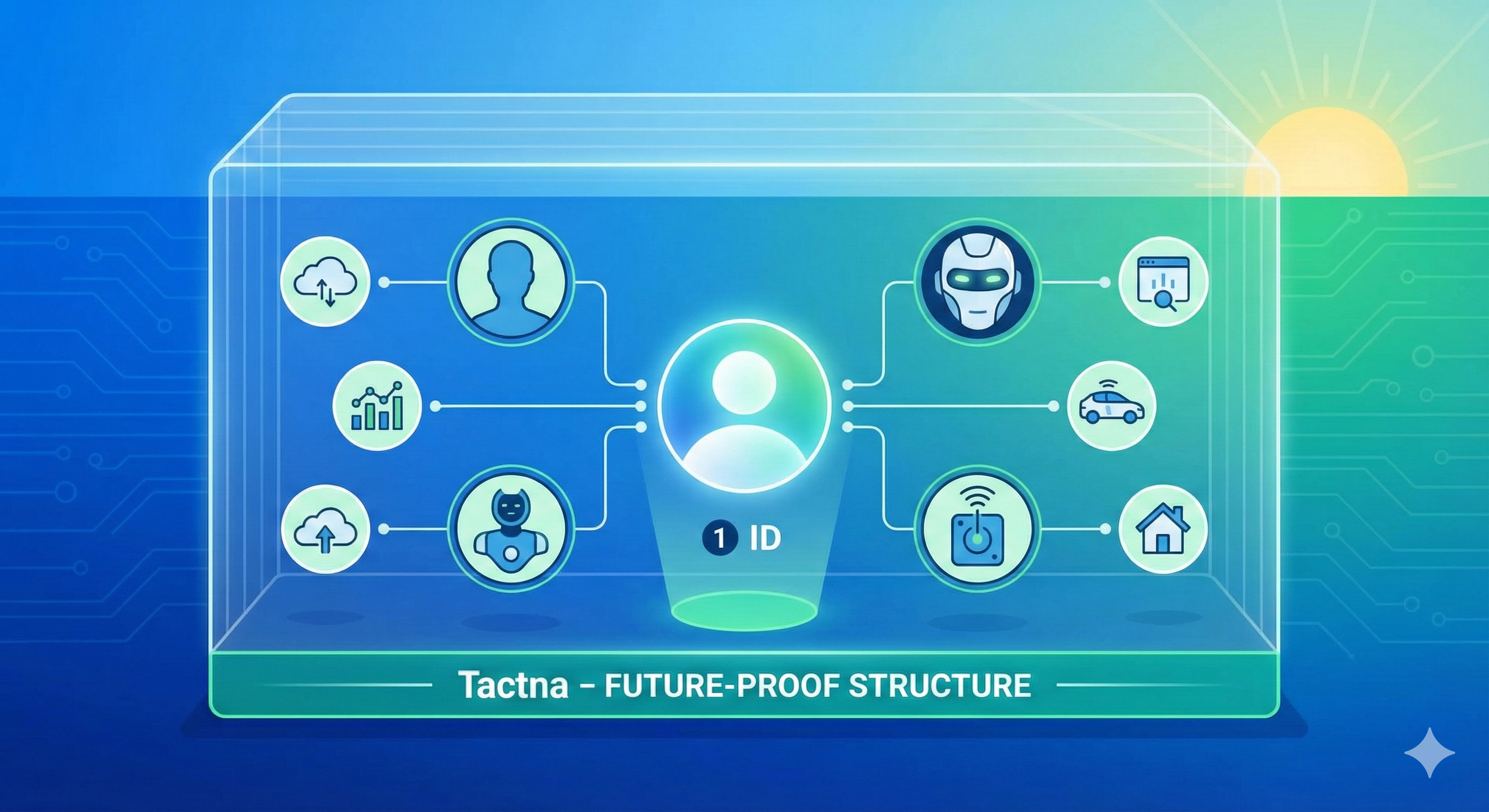
Sudo: Finally, a word on the future. ID integration isn't just about cleaning up systems. We are entering an era where AI agents will have their own IDs and access services just like humans.
Sanada: Humans, AI, edge devices... in an era where these diverse "subjects" interact, managing them on fragmented platforms is no longer possible.
Sudo: You don’t need to repeat the 25-year struggle of Topcoder. By putting your IDs into the "organized box" that is Tactna now, you can smoothly adapt when AI utilization becomes mainstream. Don't just "build authentication"—"buy a structure that can withstand future business changes."
Editor's Note
This roundtable highlighted that ID integration is about more than "organizing data"; it's about "reclaiming business freedom".
A "God Table" that tightly couples user info to a specific app becomes a shackle for future expansion. Tactna offers the process and expertise to escape this debt safely and gradually while respecting your current operations.
If you face the challenge of wanting to integrate for the future without disrupting today's operations, please reach out to us. We would be delighted if you considered Tactna.
.png&w=3840&q=75)